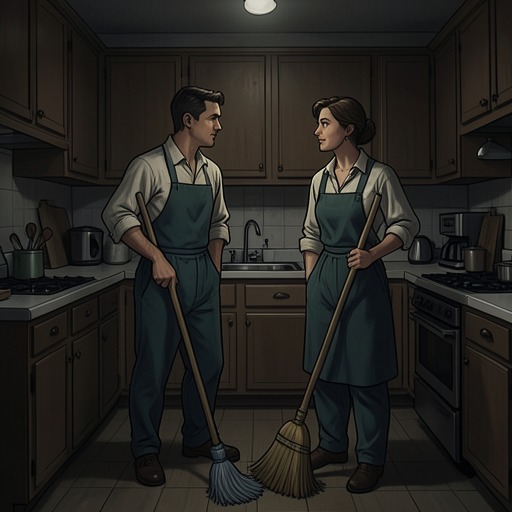
Tova’s ankle injury and time away from work
Remarkably Bright CreaturesTova Sullivan’s ankle injury interrupts the work through which she maintains order and purpose, forcing her to confront an unfamiliar need for help. A molded-plastic boot and a doctor’s six-week estimate keep her from cleaning the aquarium and tending her home as usual; in response, she tries to preserve her independence while gradually accepting support. Her time away reveals how much her daily life depends on physical labor, and how care can arrive through small, practical gestures.
Injury and the Disruption of Routine
The injury leaves Tova hobbling with her left foot enclosed in a molded-plastic boot. Dr. Remy has told her to expect six weeks of recovery, a prospect she experiences less as abstract medical advice than as a catalogue of interrupted tasks. She cannot pull dandelions from the rhubarb beds, and she imagines dust gathering along the hallway baseboards. At the aquarium, meanwhile, Terry Bailey must find someone to cover the cleaning work. Tova jokes to Cat that she could borrow one of his legs; the joke turns physical limitation into an everyday frustration rather than a dramatic spectacle.
Her concern extends beyond the inconvenience of being unable to work. Cleaning gives her a familiar role and a dependable set of responsibilities, so the prospect of others taking over unsettles her. When Terry Bailey calls, he insists that she follow the doctor’s six-week recommendation. Tova resists the full period away, and the conversation ends with a compromise: four weeks, followed by a reassessment. Terry also promises to ensure that the people covering her work are capable, including of handling the grime around the trash cans. Even in her absence, the details of the job remain on her mind.
Learning to Accept Help
Tova’s friends recognize that needing assistance is difficult for her. Mary Ann Minetti raises the possibility of help with her finances, acknowledging that she does not know how Will Sullivan arranged them. Tova’s startled response makes clear that receiving help is not something she takes for granted. The conversation places her injury within a broader question of how she will manage daily life without relying entirely on her own labor.
Ethan Mack’s offer of assistance becomes one concrete opening. Facing a drive of at least an hour each way, Tova admits that the prospect of spending two hours on the freeway makes her uneasy. Although asking is not customary for her, she decides that Ethan’s offer was sincere and accepts it. The exchange matters because it marks a change from hesitation to a direct request: she does not stop valuing independence, but permits another person to make a difficult task manageable.
Janice Kim’s care is similarly practical and attentive. She brings Tova an old mobile phone, explaining that it can be used in an emergency, and her eyes flick toward Tova’s boot as she offers it. Later, when Tova asks to use Janice’s son’s scanner, Janice notices the boot and asks whether she is managing. Tova keeps her answer even and does not explain the paperwork she needs to complete. Janice nevertheless helps her scan her driver’s license and shows her how to use the printer. The assistance is offered without requiring Tova to disclose more than she wishes.
Work, Identity, and the Aquarium
Although Terry has forbidden her to come in and clean, he has allowed her to keep her key. Tova interprets his insistence that she hold on to it as a sign of trust and confidence that she will return. While still hobbling, she uses the key for a social visit. She has come partly because she feels compelled to tell Marcellus that she plans to move to Charter Village, and partly because she wants to see how the aquarium has fared in her absence. Her concern with its cleanliness persists even when she is no longer responsible for maintaining it.
At the aquarium, Cameron Cassmore encounters her and learns that she is the injured cleaner. He has been doing the job temporarily for two weeks; his feet still ache after each shift, and he is surprised that Tova performs the same demanding work. Tova calls herself an injured cleaner and tells him that, for reasons separate from the injury, she may be away longer than expected. She is pleased that Terry found Cameron as a temporary solution, and judges his work adequate. Her response is both generous and professional: she welcomes the coverage without pretending that the work is effortless or that her own connection to the position has disappeared.
Care Given and Received
Tova’s injury makes receiving care visible, but it does not reduce her to a passive recipient. At the aquarium, after the octopus escapes its tank, she and Cameron are both caught up in the effort to respond. Cameron helps her down from a table after she has startled and fallen; she then notices the cut on his head, retrieves a Band-Aid from her purse, and insists that he take it. The neon-pink strip on his temple is a small reversal of the expected roles: the injured cleaner is also the person who notices and tends to someone else.
A later emergency with Marcellus makes the physical demands of care plain. Finding him pale and dry on the tile, Tova hurries to the supply closet despite the pain in her back and returns with her yellow mop bucket filled with several gallons of water carried from his tank in an old milk jug. She wets his skin with tank water until he has enough strength to move, then helps him into the bucket. The scene is not evidence that her ankle injury remains unresolved, but it echoes the importance of bodily limits and practical care that her recovery has already brought into focus. Across her time away from work, assistance does not erase Tova’s agency; it becomes part of a reciprocal pattern in which she accepts help when she needs it and continues to offer it when someone else is vulnerable.